Overview
Orient the review around the shipment picture and exceptions that need attention.
For brands, manufacturers & retailers
Cortrex Sentinel is designed to connect shipment evidence, operating context and human expertise—helping teams recognize emerging risks and choose practical responses within the realities of their supply chain.
Designed into your supply chain—not bolted onto it.
Preventing loss and damage starts with understanding how your goods move, where exposure develops, and which responses your operation can support.
Expertise before deployment
Our ambition is to eliminate preventable supply-chain loss. The first step is understanding the conditions that create it.
A separately scoped paid Consulting & Advisory engagement combines interviews, operating records and data review, followed by targeted site observation where useful. It can identify process, packaging, receiving, custody, carrier, and security improvements that need no Cortrex technology.
Discovery delivers findings whether or not Sentinel is deployed. Recommendations are shaped around your operation, including work delivered with 3PL and logistics-service partners.
Consulting & Advisory can stand alone. No technology purchase is required.
Cortrex is a potential technology supplier. Advisory findings remain separate from any Cortrex implementation proposal, and that commercial interest is disclosed.
The complimentary introductory shipment-risk review is a bounded discovery conversation. Full discovery is a separate paid engagement with written deliverables, fees, and responsibilities.
Explore Consulting & Advisory →A clear operating picture
Four destinations organize the Sentinel demonstrator. Ask Sentinel is accessible throughout, keeping inquiry close to the evidence being reviewed.
Orient the review around the shipment picture and exceptions that need attention.
Explore forward and reverse movements, then follow a map exception into case review.
Review supporting evidence, distinguish uncertainty, and record an evidence-backed disposition.
Examine patterns and recommendations in the context of the customer’s operating constraints.
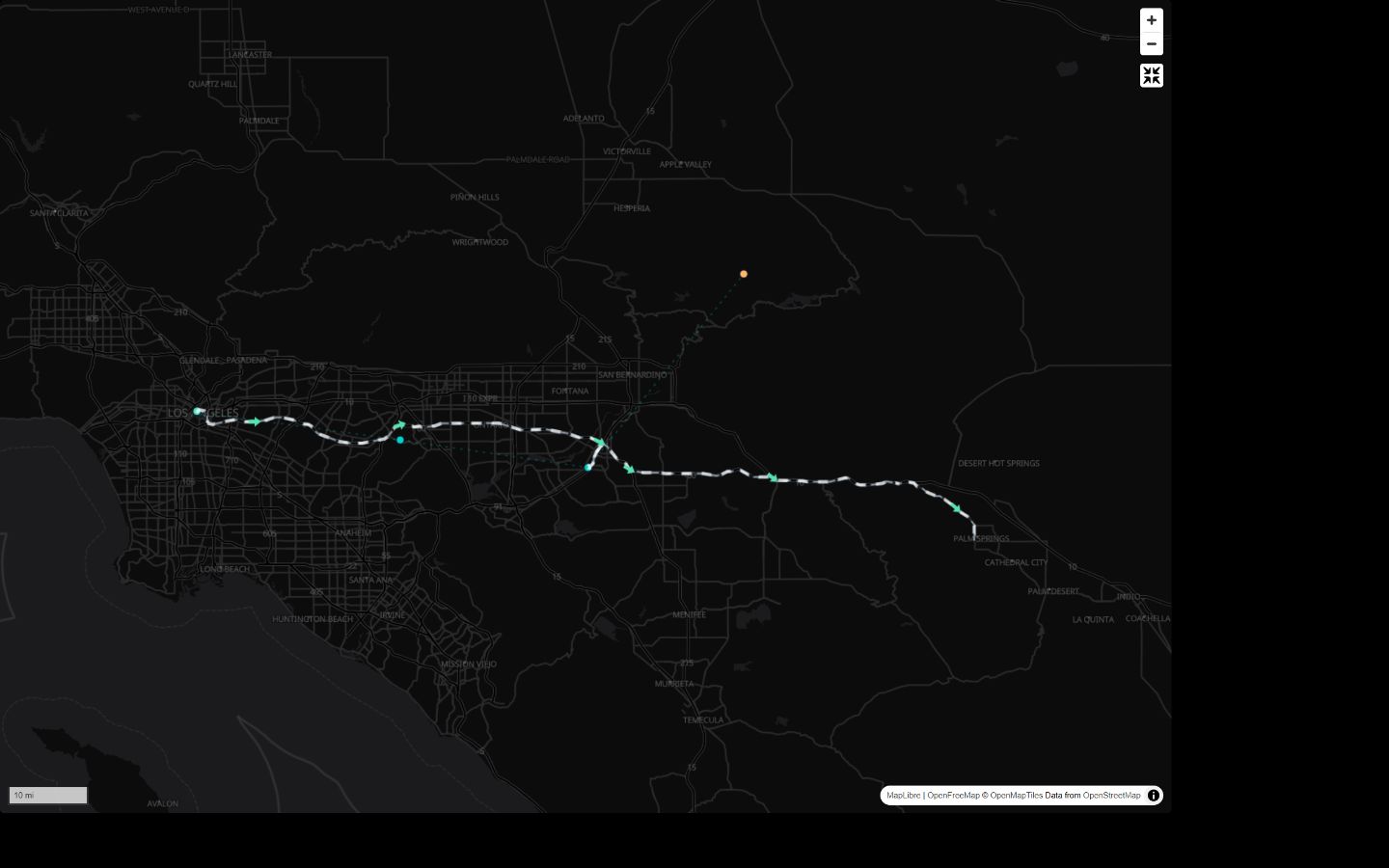 Illustrative demonstrator
From observations to decisions
Location, sensor events, custody records, receiving results, and available context can help teams distinguish an observation from an exception that warrants action.
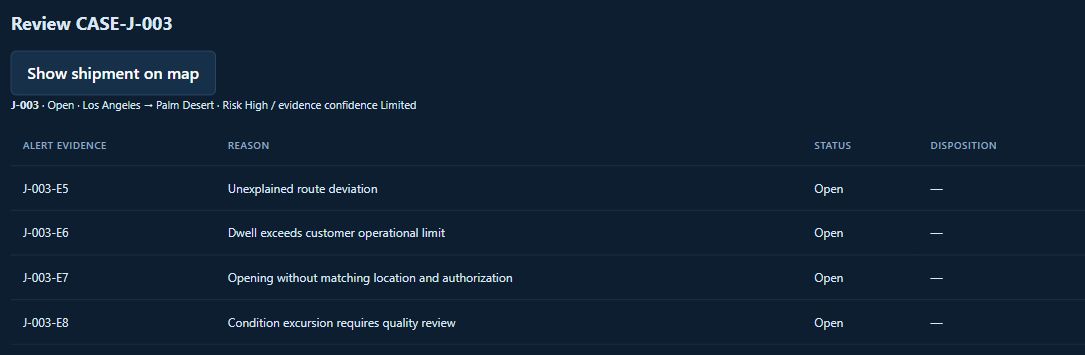 Illustrative demonstrator
A delay may reflect a receiving window, a carrier event, or an unresolved custody question. Relevant evidence helps explain what is known, what remains uncertain, and what needs human verification.
The purpose is practical: prioritize the exceptions that matter, support an evidence-backed disposition, and give the next person enough context to act responsibly.
Evidence gaps remain visible. A missing telemetry interval is not treated as continuous tracking or proof that nothing happened.
Ask Sentinel
The planned domain-focused advisor is intended to help teams explore shipment evidence, analyze patterns, compare options, and prepare reports.
“What explains repeated delays on this lane?”
“Which changes could reduce exposure without changing our store assignments?”
Answers should identify supporting evidence, uncertainty, and permitted next steps. Ask Sentinel’s current demonstrator supports defined inquiry types; broader conversational analysis and external retrieval are in development.
Recommendations that fit the operation
Warehouse and store assignments, approved carriers, receiving windows, product requirements, budgets, and tolerance for change determine which options are feasible.
Potential options include departure-day trials, carrier or service comparisons, packaging improvements, and ground/air evaluation where permitted. An option that conflicts with customer policy is not a practical recommendation.
Urgency: How soon does this need attention?
Evidence confidence: How well is the assessment supported?
Potential business impact: What could the issue or response change?
These are separate judgments. A potentially serious consequence does not make weak evidence more certain.
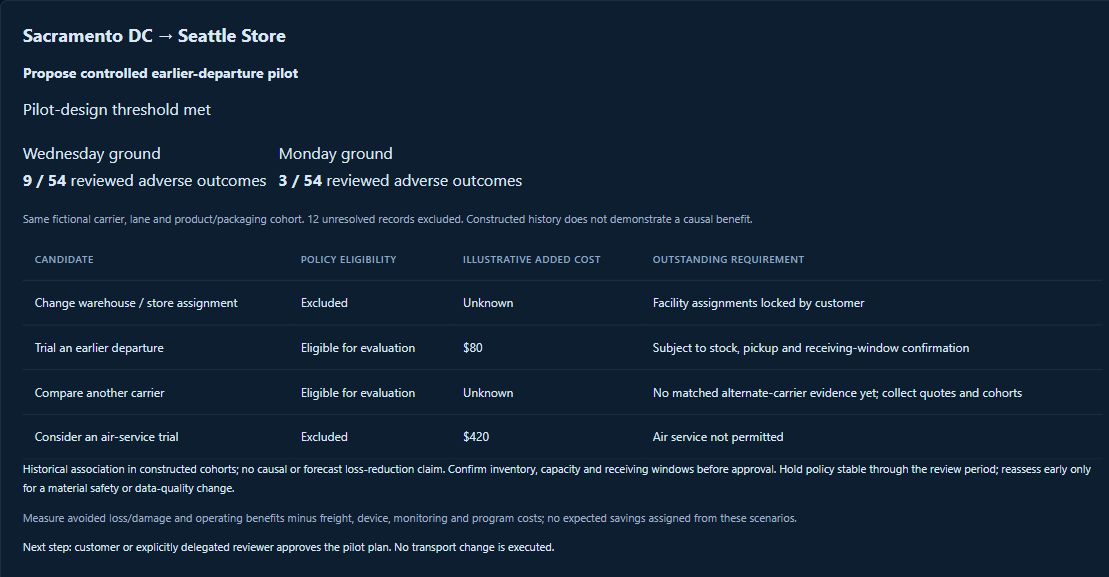 Illustrative demonstrator
Human expertise. Controlled automation.
The production vision is a semi-autonomous Global Security Operations Center capability: shipment intelligence and decision support within customer-approved operating boundaries.
Operational changes initially require human approval. Bounded automation can expand as agreed confidence and performance requirements are met, with defined permissions, escalation routes, and review.
Discovery identifies where Sentinel could work with existing processes and systems to reduce operational friction. Some process or integration changes may be necessary; fit is established for each engagement.
Measured business value
Assess improvement using full shipment denominators, reviewed outcomes, comparable baselines, and controlled interventions.
Review loss and damage alongside detection, verification, response effort, and relevant service outcomes—not only selected incidents.
Account for differences in lanes, products, carriers, and operating conditions. Historical correlation alone does not establish that an intervention will work.
Evaluate avoided loss/damage and operational benefits against transport, device, monitoring, and full program costs.
Built for the logistics ecosystem
Planned integration paths include TMS, WMS, ERP, carrier, and device connections. Discovery identifies which evidence sources and workflows a customer would need.
Cortrex Secure™ focuses on IoT and packaging innovation. Cortrex Sentinel™ focuses on shipment intelligence and decision support. Together, they can connect evidence closer to the asset with context for practical decisions.
Explore either offering or a combined approach.
Explore Cortrex Secure™ →Start with your operation
Explore a defined inquiry, an evidence-backed case, and a recommendation constrained by a realistic operating requirement.
The demonstration inquiry opens with Sentinel Demonstration selected. We will discuss the demonstrator and your interests before arranging next steps; a request does not confirm an appointment.
Business enquiries: securityreview@cortrexsystems.com